Technology Insights
Outgrowing Kintone, Ragic or Excel? When to Move to a Custom System
Low-code platforms such as Kintone and Ragic, along with Excel, are a good way to get your first processes online. When data has to be moved between systems by hand, permissions and exception rules keep piling up, field staff need a dedicated app, or headcount keeps pushing the annual fee higher, it is time to evaluate a custom system. This article lists five signals, uses published list prices to compare the 3-year total cost of a subscription and a custom build, and explains how to migrate data from a platform or Excel.
Key takeaways
- Low-code platforms and Excel suit the stage when processes are still taking shape and few people use them; outgrowing them is not a mistake, it means the business has changed.
- Five signals that it is time to evaluate a custom system: data moved between systems by hand, permissions and exception rules piling up, field staff or customers needing a dedicated app, reports and data volume slowing work down, and headcount driving the annual fee up.
- Compare a subscription and a custom build on 3-year total cost: the platform costs the per-user annual fee times headcount, while custom costs the build fee plus yearly maintenance and hosting, so the more users, the faster custom pays back.
- For data migration, inventory the fields, clean the master data and build a mapping table first, then run a trial migration, verify it, run both systems in parallel, and keep the old platform read-only for a while before retiring it.
- You do not have to replace everything: keep simple forms on the platform, build the core process as a custom system, and connect the two through an API.
Contents
Low-code platforms such as Kintone and Ragic, along with Excel, are a good way to get your first processes online. When data has to be moved between systems by hand, permissions and exception rules keep piling up, field staff need a dedicated app, or headcount keeps pushing the annual fee higher, it is time to evaluate a custom system. This is not a comparison of which tool is better; it is a way to judge which stage your company has reached.
What stage are low-code platforms and Excel good for?
They suit the stage when processes are still taking shape, few people use them, and data mostly flows inside the company. Building forms on a platform and tracking lists in Excel is quick to launch and quick to change, which makes it a sensible choice.
The strength of a low-code platform is that business teams can build things themselves: request forms, customer lists, simple approvals and reports, without writing code. Almost everyone already knows Excel, so the upfront cost is the lowest of all. Many companies use these two tools to first pull together data scattered across paper and messaging apps.
The problem is usually not the tool but the fact that the company has grown: more people, more branches, more systems to connect, and what used to be enough now needs manual work to fill the gaps. The five signals below help you tell whether you have reached that point.
Which five signals mean it is time for a custom system?
If you see two or three of the five signals below, a custom system is worth evaluating. With only one, adjusting the platform settings or adding an integration usually solves it, and there is no need to replace everything.
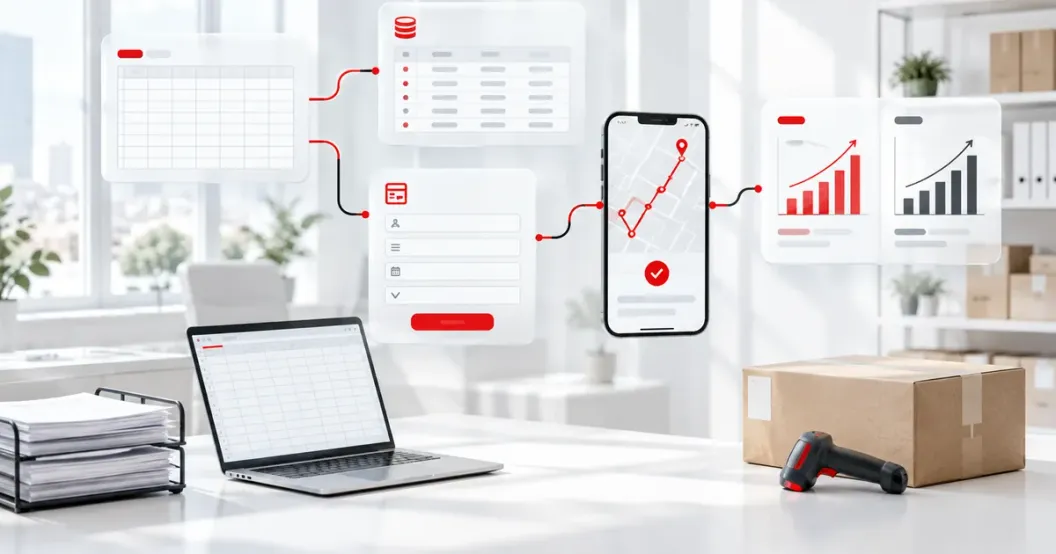
- Data is moved between systems by hand. Orders live on the platform, shipping in the ERP, invoices in another system, and someone exports, tidies and re-imports every day, keying the same record twice.
- Permissions and exception rules keep piling up. With several branches and roles, each person sees different fields; approvals are full of "skip this step in case A, add a sign-off in case B", and the settings get harder to maintain.
- Field staff or customers need a dedicated app. Drivers, field technicians and members need screens designed around their work, such as scanning codes, photo reports and offline use, and generic form screens do not fit well.
- Reports and data volume slow work down. After a few years of data, reports take a long time to run or have to be exported to Excel first; several people edit the same Excel file and the versions no longer match.
- Headcount keeps raising the annual fee. Platforms are mostly priced per user, so going from 20 to 60 users triples the annual fee, and you pay it every year.
Behind all five signals is the same shift: the system now has to fit your company's own processes, rather than your processes fitting the tool.
How do you calculate the 3-year total cost of a subscription versus a custom build?
Convert both into a 3-year total cost before comparing. A platform costs the per-user annual fee times headcount and years, plus add-ons, integrations and consulting; a custom system costs the build fee plus yearly maintenance and hosting. The more users, the faster custom pays back.
Gartner defines total cost of ownership (TCO) as all the direct and indirect costs of acquiring, using and maintaining a system. Here is how each side adds up:
| Item | Low-code platform (subscription) | Custom system |
|---|---|---|
| One-time costs | Implementation consulting and template setup, if any | Build fee and data migration |
| Fixed yearly costs | Per-user annual fee × headcount | Maintenance + hosting or cloud |
| Changes with headcount | Yes, more users cost more | Usually not |
| Other | Add-ons, integrations, extra storage | Enhancement releases |
| After you stop | You cannot log in once the subscription ends, so export data first | Keeps running if the source code is delivered under the contract |
Published list prices (checked on November 4, 2026, before tax; the official sites are authoritative):
- kintone: Standard plan NT$6,300 per user per year, Lite plan NT$3,420 per user per year, minimum 5 users.
- Ragic: Professional plan US$19 per user per month, Lite plan US$5 per user per month, priced in US dollars.
Here is a worked example. The custom build fee, maintenance fee, add-on and integration costs, and exchange rate below are all assumptions used only to show the method; they are not a quote from JoinX or any vendor. Assume add-ons, integrations and consulting cost NT$100,000 a year; a custom build costs NT$800,000, with NT$150,000 a year for maintenance and hosting; and US$1 = NT$32.
| 3-year total cost example | 20 users | 60 users |
|---|---|---|
| kintone Standard (list price) + add-ons and integrations (assumed) | NT$678,000 | NT$1,434,000 |
| Ragic Professional (list price, assumed exchange rate) + add-ons and integrations (assumed) | NT$738,000 | NT$1,613,000 |
| Custom system (all assumed values) | NT$1,250,000 | NT$1,250,000 |
Under these assumptions, the platform is cheaper at 20 users; at 60 users, custom is already cheaper by year 3. You can also estimate the break-even point with this formula:
Payback years = custom build fee ÷ (platform yearly total − custom yearly maintenance)
For 60 users on kintone Standard: 800,000 ÷ (478,000 − 150,000) ≈ 2.4 years. At 20 users it is 800,000 ÷ (226,000 − 150,000) ≈ 10.5 years, so custom does not pay off.
What the example leaves out is the staff time spent filling process gaps by hand: one hour a day of exporting and importing adds up to more than two hundred hours a year. Once that time is counted as a cost, it is often the real reason companies decide to switch. For the full method across three ERP payment models, see How to calculate custom ERP costs.
Do you have to replace everything? What other options are there?
Not necessarily. You can keep the platform for simple forms and requests, build the core process as a custom system and connect the two through an API, or start by turning only the most painful step into a small system. Replacing everything is usually the last step.
| Approach | When it fits | Watch out for |
|---|---|---|
| Stay on the platform, adjust settings or add plug-ins | Only one signal, and processes rarely change | When plug-ins come from different vendors, agree who is responsible for upgrades and maintenance |
| Platform + integration | The platform is good enough but needs to exchange data with the ERP, POS or invoicing system | The more integration points, the higher the maintenance cost |
| Custom core process, simple forms stay on the platform | The core process is a competitive advantage and the rest is standard | Decide which side is the source of truth for master data |
| Replace everything with a custom system | Three or more signals, and headcount keeps growing | Leave time for data migration and parallel running |
Both kintone and Ragic offer APIs, so "platform + integration" and "partial custom" are both workable transition paths.
How do you migrate data from a platform or Excel?
Follow six steps: inventory, clean, map, trial migration, parallel run, and cutover. The most common problems are duplicate master data and inconsistent field definitions, so cleaning has to happen before the trial migration, not after.
- Inventory. List every form and Excel file in use, the field names and who uses them, and flag the ones nobody uses anymore.
- Clean master data. Deduplicate and standardize master data such as customers, products and employees, for example when one customer appears under three names.
- Build a field mapping table. Map each old field to a new one and write down the conversion rules, such as date formats and dropdown codes.
- Trial migration and verification. Migrate part of the data first and have the people who use it check record counts, amounts and attachments.
- Parallel run. Run the old and new systems side by side for a while, for example one closing cycle, to confirm the numbers match.
- Cutover and retention. After the cutover, keep the old platform read-only for lookups for a while, then take a full backup and retire it.
Most platforms can export data to CSV or Excel, but attachments, comments and history are not always included, so confirm the export scope first. When the data includes personal data of customers or employees, Article 8 of the Enforcement Rules of Taiwan's Personal Data Protection Act requires agreeing on how data is returned and deleted when a vendor's engagement ends.
How does JoinX build custom systems?
We launch the core process first, then add releases as operations require, instead of building everything at once. This keeps the upfront budget under control and lets you decide the next step after real use.
JoinX takes on small systems from NT$150,000, and a simple ERP starts at about NT$450,000; the actual cost depends on the number of modules, integrations and the scope of data migration. Code ownership and handover are written into the contract, and the source code is delivered to the client.
Real examples of growing a system release by release:
- 欣晨快遞: development of its logistics management system and driver APP began in 2025 and has grown in phases to a fifth version as operations required. See the 欣晨快遞 case study.
- 驊曖體育: we began working on its yoga studio management system in 2020 and have released versions up to the ninth. See the 驊曖體育 case study.
Frequently Asked Questions
We already use kintone or Ragic. Do we still need a custom system?
Not necessarily. With only one signal, adjusting settings, adding a plug-in or building an integration is usually enough. With two or three signals, or steadily growing headcount, evaluate building the core process as a custom system while simple forms stay on the platform.
Is going straight from Excel to a custom system too big a jump?
It depends on how stable your processes are. If they still change often, a low-code platform can help you settle them first. If they are stable and you need cross-system integration or a field app, you can go straight to a custom system, starting with the most important part.
Can all the data on the platform be moved over?
Form data usually can, since most platforms export to CSV or Excel. Attachments, comments, approval records and edit history are not always included in the export, so confirm the scope first, and handle them separately or keep the old platform read-only for lookups if needed.
Is a custom system hard to change after launch?
It depends on the contract and documentation. If the source code and technical documents are delivered to you and the maintenance scope is clear, later changes can be scheduled into releases. Most JoinX clients keep adding releases after launch rather than freezing the system.
Is a custom system always more expensive than a subscription?
It always costs more upfront, but not necessarily over time. Platforms charge per user, so the annual fee rises with headcount; a custom build fee is paid once, followed by maintenance and hosting. When you put the 3-year totals side by side, custom is often cheaper for larger teams.
Sources
- kintone pricing (kintone.tw/price)Cybozu, Inc. Taiwan Branch
- Ragic pricing plans (ragic.com/intl/zh-TW/pricing)Ragic
- Total Cost of Ownership (TCO), Gartner GlossaryGartner
- Enforcement Rules of the Personal Data Protection Act, Article 8Ministry of Justice, Taiwan
These are the regulations and sources cited at the time of writing. Rules may be revised; always check the latest official announcement.
About the author
Jack Lee
Founder & CEO, JoinX
Jack founded JoinX in 2016 and leads a team of 80+ people across Taiwan and Japan. JoinX has delivered 520+ projects for 220+ clients, including 56 mid-to-large systems.
More about Jack