Technology Insights
Education and Retail System Development Cases: CooC-Cloud, ITRI's Live Course Platform and 比漾百貨's Online Store
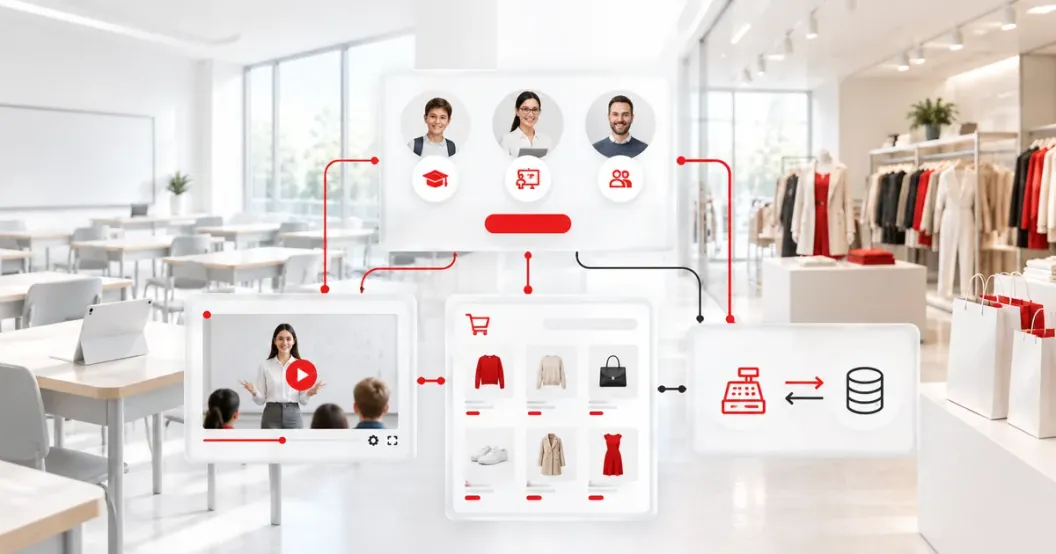
For education, the hard part is letting many kinds of users share one entry point, meeting public-sector security rules, and adding services over time. For retail e-commerce, the hard part is connecting to the ERP, POS and accounting systems already in place. This article walks through three education and retail projects JoinX has delivered: Taipei CooC-Cloud for the Taipei City Government Department of Education, an online live course platform for ITRI, and the website and online store for 比漾百貨. For each we cover the starting point, what we built and how long we have worked together, followed by how the two kinds of systems differ and what they cost.
Key takeaways
- Education platforms serve many user roles, face strict security rules and keep adding subsystems, so they should be planned around a single entry point and modules from the start.
- JoinX maintains and extends Taipei CooC-Cloud for the Taipei City Government Department of Education, bringing 9 subsystems under one entry point for the bureau, schools, teachers, students and parents.
- JoinX built an online live course platform for ITRI, and the two organizations worked together from 2020 to 2024.
- 比漾百貨 kept its existing ERP, POS and Digiwin accounting systems; JoinX built a new website and online store and connected all three, joining online and offline (OMO).
- Based on JoinX's custom project rates in Taiwan, small systems start at NT$150,000, each integration point costs about NT$50,000–200,000, and mid-sized multi-role platforms run about NT$1–2.5 million.
Contents
An education platform has to solve "many roles, many services, one entry point"; a retail online store has to solve "online orders that match the stores and the books." The two start from different places, but neither is built all at once: the core workflow goes live first, then the system grows in stages based on real use. Below are three projects JoinX has delivered in education and retail, each described by its starting point, what we built and how long we have worked together.
What problem did each of these three education and retail projects solve?
All three projects built on services or systems that already existed instead of starting from nothing. Here is the overview first, followed by the starting point, approach and partnership period of each.
| Case | Industry | System | Problem solved | Partnership period |
|---|---|---|---|---|
| Taipei City Government Department of Education | Education (public sector) | Taipei CooC-Cloud and Parent-Teacher-Student Integration Platform | Scattered campus services brought into one entry point, 9 subsystems | Since 2023, ongoing maintenance and extension |
| ITRI | Education (research institute) | Online live course platform | Courses delivered live and online | 2020–2024 |
| 比漾百貨 | Department store retail | Website and online store connected to ERP, POS and Digiwin accounting | Online and offline integration (OMO) while keeping existing systems | 2020–2024 |
For more on education projects, see digital education platform development; for how we plan retail e-commerce, see e-commerce system development.
Why should an education system be planned around a single entry point?
Because there are many user roles and the number of services keeps growing, so building each one separately leaves accounts, permissions and security fragmented. A single entry point centralizes sign-in and permissions, and new services plug in as subsystems instead of starting over.
Taipei City Government Department of Education: Taipei CooC-Cloud and Parent-Teacher-Student Integration Platform
Starting point: Building on the existing system, the department faced four problems: the interface did not fit how schools actually work, which discouraged use; after-school registration, reply-slip surveys and carbon reduction records were scattered, making both use and administration complicated; stability and security had to meet personal data rules and the required cyber security level; and the platform had to serve a large, varied user base of bureau staff, schools, teachers, students and parents.
What we built: JoinX handles the extension and maintenance of the Taipei CooC-Cloud and Parent-Teacher-Student Integration Platform, which brings 9 subsystems under one entry point and keeps adding subsystems for carbon reduction, surveys and reply slips, event registration and campus payments. Each module uses the stack that suits it: the reply-slip survey system runs on ASP.NET, MS SQL and Windows Server; the registration system uses .NET Web API with Next.js, deployed on Ubuntu; and the carbon reduction passbook is built with TypeScript and .NET Web API. On security, we follow the department's ISMS standard with vulnerability scans, version control and strict access control; for operations we set up support, monitoring and incident reporting ranging from 5×8 to 7×12, with regular backups and log audits. Security responsibilities for government systems are set out in the Cyber Security Management Act, and because the platform handles large volumes of student and parent data, access is controlled under the Personal Data Protection Act. See the Taipei CooC-Cloud case study for the full story.
Partnership period: Since 2023, more than 3 years so far, with maintenance and extension ongoing.
What should be settled first for an online live course platform?
Settle how courses are opened, who can watch, how the live stream is delivered and how recordings are kept afterward. A live platform is more than putting video online: registration, permissions, playback and replay form one chain, and if any link breaks, learners cannot get into class.
ITRI: online live course platform
Starting point: The research institute needed a platform that could deliver its courses and talks live and online, so learners could attend without being on site.
What we built: JoinX developed the online live course platform for ITRI and handled its maintenance after launch.
Partnership period: 2020 to 2024.
A retailer already has an ERP and POS. How should the online store connect?
Keep the existing ERP, POS and accounting systems, build a new online store, and use integrations to keep products, orders and accounting in sync. Retail processes are similar across the industry, so replacing the whole ERP usually costs far more and carries far more risk than adding an online channel.
比漾百貨: website and online store connected to ERP, POS and Digiwin accounting
Starting point: 比漾百貨 already ran an ERP, POS and Digiwin accounting system, and wanted to add a website and online store while keeping online and offline data consistent.
What we built: JoinX built the website and online store for 比漾百貨, kept the existing ERP, POS and Digiwin accounting systems, and used integrations to sync the data, achieving online and offline integration (OMO), with ongoing maintenance after launch. When an online store connects to accounting, e-invoice issuing, voiding and allowances must match the ERP; the Ministry of Finance's Directions for the Implementation of E-Invoices set out the process. Return rules for online purchases must also follow the Consumer Protection Act's provisions on distance sales. For integration details, see 4 ways to connect a Digiwin ERP to e-commerce and POS.
Partnership period: 2020 to 2024.
How do education platforms and retail online stores differ in planning?
Education platforms deal with roles and permissions first; retail online stores deal with data sync and accounting first. Both must run reliably after launch, but they fail in different places: education platforms fear misassigned permissions and data leaks, retail stores fear inventory, orders and books that do not match.
| Planning item | Education platform | Retail online store |
|---|---|---|
| Main users | Bureau, schools, teachers, students, parents and other roles | Consumers, store staff, headquarters operations and accounting |
| Define first | Roles, permissions and single sign-on | Data flow for products, inventory, orders and accounting |
| Systems to integrate | Account system, existing school or registration services | ERP, POS, accounting, payments and logistics |
| Security and regulation | Public-sector security rules, personal data protection | Personal data protection, e-invoices, distance-sale return rules |
| How it grows | Subsystems added one at a time | Channels or integration points added one at a time |
| Most common requests after launch | New subsystems, changes to follow policy | Campaigns, new payment methods, reports |
How much does an education platform or retail online store cost to build?
Based on JoinX's custom project rates in Taiwan, a small single-purpose system starts at NT$150,000, each integration point costs about NT$50,000–200,000, a mid-sized multi-role, multi-process platform runs about NT$1–2.5 million, and platforms that bring several subsystems under one entry point are quoted by scope.
| Scope | Estimated cost | Typical contents | Typical timeline |
|---|---|---|---|
| Requirements mapping | NT$100,000–300,000 | Map roles, processes and systems to integrate, and produce a comparable spec | 2–4 weeks |
| Small system | From NT$150,000 | A single-purpose tool, such as a registration form or campaign back office | Depends on scope |
| Integrating one system | NT$50,000–200,000 per integration point | Data sync between the online store and one of the ERP, POS or accounting systems | Depends on the other side's interfaces |
| Mid-sized platform | NT$1 million–2.5 million | A multi-role, multi-process course platform or online store with several integrations | 5–8 months |
| Integrated platform | Quoted by scope | Several subsystems under one entry point, with data migration and phased launch | 8–18 months |
These are starting points for budgeting, not fixed quotes; actual pricing depends on requirements, and third-party services such as live streaming, SMS and cloud hosting are extra. Public-sector and education clients usually require security documentation: before delivery, JoinX runs its own source code scans and vulnerability scans; when black-box testing is needed, a third party performs it, JoinX can help arrange and recommend vendors, and we fix the findings before delivery.
What should you prepare before starting an education or retail system project?
Prepare a list of user roles, a list of existing systems and the scope of the first release. All three projects launched one core workflow first and then grew based on real use; the more concrete your preparation, the more accurate the quote and timeline.
- List every user role. Who signs in, and what each role can see and change; education platforms in particular must separate bureau, school, teacher, student and parent roles.
- List existing systems and data. Which interfaces your account, school administration, ERP, POS and accounting systems expose, and where data comes from and goes.
- Choose the first-phase scope. For example, launch registration and reply slips first, or the website and product pages first, and move other features to the next phase.
- Confirm security and regulatory requirements. The public-sector security level, how personal data is stored and deleted, and e-invoice and return rules.
- Agree on maintenance. Support hours, monitoring and incident reporting, backup frequency, and how new features are requested and quoted after launch.
Frequently Asked Questions
Can an education platform be extended on top of the existing system instead of rebuilt?
Yes. CooC-Cloud integrates and extends subsystems on an existing platform, connecting registration, reply slips, carbon reduction and payments through one entry point. As long as accounts and permissions can be managed centrally, new services can usually be added as subsystems without a full rebuild.
Does a retailer have to replace its ERP to launch an online store?
Not necessarily. 比漾百貨 kept its existing ERP, POS and Digiwin accounting systems, built only a new website and online store, and synced the data through integrations. When the existing ERP's accounting and inventory functions are good enough, integration usually costs less and carries less risk than replacing the ERP.
How far does security need to go for public-sector or education systems?
It depends on the agency's cyber security responsibility level and security rules. For CooC-Cloud, JoinX follows the department's ISMS standard with vulnerability scans, version control and access control, and runs processes for monitoring, incident reporting, backups and log audits.
Does an online live course platform need maintenance after launch?
Yes. A live platform depends on streaming services, playback devices and browser versions, and that outside environment keeps changing, so someone has to monitor it, handle incidents and keep it updated after launch. JoinX handled both development and maintenance of ITRI's online live course platform.
Who owns the source code, and can we switch vendors later?
The full source code is delivered to the client. JoinX builds with its own team and does not subcontract, so you can maintain it yourself, sign a maintenance contract or hand it to another team; just spell out documentation and handover in the contract.
Sources
- Cyber Security Management ActMinistry of Digital Affairs
- Personal Data Protection ActMinistry of Justice
- Directions for the Implementation of E-InvoicesMinistry of Finance
- Consumer Protection ActLaws & Regulations Database of the Republic of China (Taiwan)
These are the regulations and sources cited at the time of writing. Rules may be revised; always check the latest official announcement.
About the author
Jack Lee
Founder & CEO, JoinX
Jack founded JoinX in 2016 and leads a team of 80+ people across Taiwan and Japan. JoinX has delivered 520+ projects for 220+ clients, including 56 mid-to-large systems.
More about Jack