Technology Insights
How to Choose a Hotel PMS: Channels, Housekeeping and Billing
Choosing a hotel management system comes down to whether one booking can move smoothly through intake, room assignment, check-in, cleaning, spending and checkout. If your main pain is updating room counts on each booking site by hand, evaluate channel management first. If the front desk cannot tell whether rooms are ready, check the housekeeping functions in your PMS. If your PMS runs reliably and only restaurant billing or multi-property data will not connect, compare extensions and integration first rather than rebuilding the whole system.
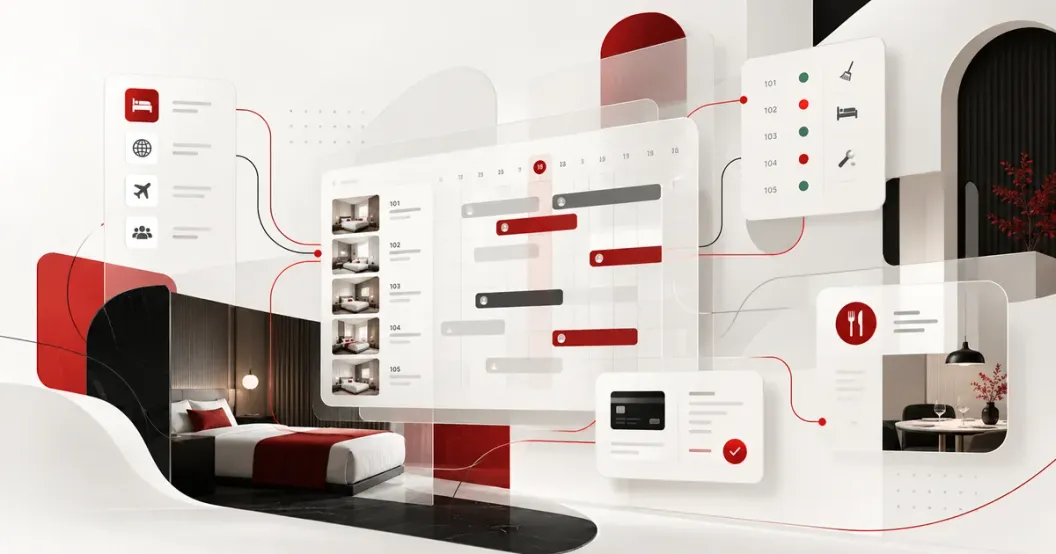
Key takeaways
- A PMS, website booking and channel management do different jobs. The PMS runs lodging operations, a booking engine lets guests book online, and channel management helps sales channels exchange rates, availability and orders; confirm which parts are actually included before you buy.
- An available room is not necessarily ready for check-in. Sellable room-type counts, the actual room assigned and whether that room has been cleaned should be managed separately, with the front desk able to see how they relate.
- Restaurant charges must attach to this specific stay, not just a room number. For room moves, checkouts and voided transactions, staff should be able to trace the original charge and its corrections, so the next guest never inherits the previous guest's bill.
- Not every property needs custom development. Choose a mature product first for basic booking and check-in; evaluate development only when essential workflows, existing equipment or cross-system exchange genuinely cannot be supported.
- A first conversation does not need a full specification. Bring one record from booking to checkout, the names of your current systems and the work you redo most often, and you can start working out whether it needs a setting change, an add-on module or integration.
Contents
What really eats up a hotel's day may be confirming which date a guest changed, phoning housekeeping to ask whether a room can be handed over, or chasing last night's restaurant charge before checkout. This article focuses on hotels with front desk and housekeeping teams working together. It explains what each type of system is responsible for, which tasks to ask vendors to demonstrate, and when it makes sense to bring in JoinX. The operational examples below are planning scenarios and do not mean every product offers the same functions.
What Is the Difference Between a Hotel Management System, PMS, Booking Engine and Channel Manager?
Key takeaway: "Hotel management system" is a broad term. A PMS usually handles reservations, check-in, room status and lodging accounts, while website booking engines and channel management handle sales and order exchange. Products may be bundled or priced separately, so judge them by how the work gets done, not by their names.
PMS stands for Property Management System, which in lodging means the operational management system of a hotel or inn. Academic literature describes its scope as covering reservations, room assignment, guest data, housekeeping and related system integration, but that does not mean every PMS has all of these modules built in. When a product says it "supports booking," you still need to confirm whether that means staff entering bookings by hand at the front desk or guests booking for themselves on your website.
| System or function | Main users and work | What you should see when choosing |
|---|---|---|
| PMS / hotel management system | Front desk and operations staff handle reservations, room assignment, check-in, checkout and room accounts | The status and charges of a single stay can be tracked continuously |
| Website booking engine | Guests choose dates, room types and packages and complete their booking | Booking results reach the operating system without staff retyping them |
| Channel manager | Reservations staff manage online travel agency (OTA) channels | Rates, availability and orders are exchanged as agreed, and someone handles exceptions |
| Housekeeping management functions | Housekeeping staff receive cleaning assignments and report progress | The front desk can look up whether a room is ready, rather than just getting group chat messages |
| POS (point of sale) and financial systems | Restaurant staff record spending; finance handles payments, reconciliation and accounting | Every charge has a source, and paid and outstanding amounts are clearly separated |
Guesthouses with a small number of rooms and simple lodging services can start with an easy-to-use off-the-shelf solution that handles booking and channels well. Only hotels with restaurants, group guests, corporate monthly billing or multiple properties need to go further and verify whether all of this can be handled by one product or work with existing tools. You cannot conclude that custom development is necessary from room count alone.
When Bookings Come from Different Platforms, How Do You Keep Room Counts and Changes Consistent?
Key takeaway: First decide which system manages sellable counts by date and room type, then link bookings, cancellations and date changes back to the same record. Even connected channels can run into delays or failures, so the system has to let staff see which orders have not been confirmed as complete.
Suppose a hotel sells the same double room on its website and two OTAs. When a guest books one through a channel, the system receiving the order should update the sellable count for that stay period and then update the other channels through the established mechanism. Phone bookings must also go through the same inventory control process. If phone bookings are first written on paper and entered only at the end of the shift, the rooms held during that time will not be reflected, even if the online connections work perfectly.
Changing a stay is not just changing the date on screen. You should first confirm that the new dates have rooms, reconfirm the rate and any payment difference as agreed, and then adjust occupancy for both the old and new dates together. Cancellations should separately track "booking cancelled" and "refund completed" rather than merging the two into one completed checkbox. That way the front desk can answer both whether the room has been released and whether the guest still has money pending.
| Demo scenario | Ask the vendor to show you | What managers should confirm |
|---|---|---|
| An online booking is made | The order reaches the PMS and other sales channels update room counts | The front desk does not re-enter it, and the source order can be looked up |
| A guest changes stay dates | Occupancy is adjusted for both old and new dates | It is not just a note; the original rate and change history remain available |
| The front desk holds a room by phone | A hold is created along with how its expiry is handled | There are clear rules on whether the hold takes inventory and who releases it when it lapses |
| An order exchange fails | Incomplete items are displayed and staff reprocess them | Resending does not create a duplicate order, and failures are not treated as successes |
If what you do most today is manually opening and closing rooms on each platform, first see which channel management tools your existing PMS can work with. Evaluate writing a separate connection only when the vendor and mature channel products cannot support an essential workflow. Developing your own also does not mean you can directly obtain connection rights to every OTA.
How Can Housekeeping, Room Moves and Extended Stays Work Without the Front Desk Constantly Asking?
Key takeaway: Record "whether a guest is in the room," "whether the room has been cleaned" and "whether it can be assigned again" separately, and have housekeeping reports directly update the status visible to the front desk. Room moves and extensions should trigger updates to work assignments, so staff are not working from an outdated cleaning list.
For example, after a guest checks out, the room may still be waiting for cleaning. Once housekeeping finishes, it may still need a supervisor's inspection, or an equipment problem may remain unresolved. A more practical screen does not just show red or green; it lets the front desk know which step the room is stuck at and who is handling it, with the hotel's own rules deciding when a room can be handed over. Cleaning status also should not be equated directly with sellable inventory on future dates, or a room not yet cleaned today might be wrongly deducted from future inventory.
Housekeeping staff do not need to see full payment information. They need to know which rooms they are responsible for today, whether each is a checkout clean or a stayover tidy, whether anything has priority, and how to report when done. A simple mobile page or an existing housekeeping module can do this. If they still have to go back to the office and copy out cleaning records, the new interface has not really reduced any work.
For a room move, the cleaning assignment for the original room, the check-in status of the new room and the guest data must be adjusted together. For example, if a guest moves out because of an air conditioning problem, the original room should go into a pending state rather than immediately returning to ready just because no guest is in it. For an extension, first confirm subsequent room assignments, then update the stay period and housekeeping tasks so staff know a room expected to check out is now a stayover.
You can start this part by having one front desk colleague and one housekeeping colleague test it together: one performs a room move while the other checks whether their list changes accordingly. If your existing PMS can already do this and permissions or workflows simply were not configured, fix the settings and procedures first. Consider building an interface only after confirming there is a real functional gap.
How Do Restaurant Charges and Lodging Fees Reach the Same Room Account?
Key takeaway: The point of connecting POS to PMS is to record charges against the correct stay while keeping the original transaction and its corrections linked. A room number is only a lookup condition; it cannot on its own determine which guest should pay.
Imagine a guest eats at the restaurant and asks to charge it to the room, meaning it will be settled together at checkout. Restaurant staff should confirm the guest and their charging eligibility according to hotel rules, then send the amount and items to the corresponding stay. When the front desk opens the room account, they can see which outlet the charge came from and when. If the data failed to send, the restaurant should be able to see a pending record, rather than assuming the front desk received it because someone pressed send.
The same room number is used by different guests over time, and guests may also move rooms mid-stay. So the data relationship should identify the stay record instead of keeping all spending under the room number forever. Voiding a charge should also keep a correction record, so the front desk can see how the original transaction was reversed. Before resending an unconfirmed transaction, the system must also be able to tell whether it was already posted, so the same meal does not appear twice.
Packages and split payments are also worth spelling out during demos. For example, if a lodging package includes breakfast, redeeming breakfast confirms the use of a benefit and should not automatically add another breakfast charge. If a company pays only for the room while the traveler pays for meals, settlement must be split according to the payment arrangement. These are data and work rules that operations and finance should confirm first, before deciding how the system does it.
In a 2024 iThome interview with hotel IT executives, the industry was described as still having work such as transcribing OTA booking data and manually exchanging restaurant and membership data. This is a reminder for buyers: after purchasing different systems, you still have to check whether staff are moving data between them. If the PMS and POS can both stay in use, ask the existing vendors about their integration options first, then compare the scope and maintenance responsibilities of separate development.
If You Already Have a PMS, Door Locks and Accounting Systems, Which Part Should You Integrate First?
Key takeaway: Start with the work that is repeated most each day and whose errors most affect reception or checkout, and designate which system is responsible for each type of data. Do not build one overview screen that lets multiple systems freely modify the same booking, room account or room status.
If the front desk spends time every day retyping OTA bookings while housekeeping and payment flows are running smoothly, the first phase should be order intake and exception handling. Conversely, if orders already flow into the PMS automatically and the bottleneck is restaurant charges not reaching the front desk in time, handle room account exchange first. Until both are done, there is no need to invest early in an attractive operations dashboard that still depends on people feeding it data.
| Data or work | Primary system to confirm first | How other systems should cooperate |
|---|---|---|
| Reservations, stay dates and room assignment | PMS or the agreed central reservation architecture | Receive changes and results, without each creating stay records that cannot be matched |
| Sellable room counts and channel sync | The designated inventory control / channel management combination | Exchange room types, dates and counts as agreed, without keeping a second manual inventory |
| Restaurant spending | POS keeps the original transaction; PMS keeps the matching room account | Corrections and cancellations trace back to the source, preventing duplicate posting |
| Door lock access | The access control system, working with approved check-in arrangements | Update access on room moves, extensions and checkout, and keep a manual fallback |
| Payment and financial data | Designated according to the operations and accounting split | Separate guest payments, channel collections and actual payouts rather than labelling them all as the same kind of received |
If you want to connect electronic door locks, first obtain the actual model and the vendor's support options, then test room moves and extensions. It is not enough to complete "send a code after booking" without handling how the original access is revoked after a room change, or who can approve activation when a guest arrives early. Whether it can be done depends on the interfaces the equipment and systems provide.
For multi-property management, systems do not have to be unified immediately. If headquarters only needs to see reports for now, you can agree on room type categories, revenue categories and reporting dates, then collect the necessary data. If you want to move guests between properties, centralize bookings or share guest services, you must go further and address the actual transaction flows. Report integration and operational integration are different scopes and should be quoted separately.
Off-the-Shelf Systems, Add-On Modules or Custom Development: How Do You Choose?
Key takeaway: Compare mature products first for standard lodging workflows. If you already have a usable PMS, first verify its settings and vendor modules. Evaluate custom development and integration only when core workflows have gaps, essential data cannot be exchanged or on-site operations genuinely do not fit.
| Current situation | Preferred approach | When to consider the next step |
|---|---|---|
| New property, mainly booking, check-in and cleaning | Choose an off-the-shelf PMS and trial it with booking and channels | Essential work genuinely cannot be completed through standard workflows |
| You have a PMS but its functions go unused | Review permissions, settings, training and vendor modules | After adjustments you still copy data repeatedly or cannot handle essential exceptions |
| PMS is stable, but POS, housekeeping and website operate separately | Compare vendor integration with partial development | You need extra interfaces, transaction rules or cross-vendor data exchange |
| Different systems across properties, and you only want central reporting | Unify data definitions and reports first | You start needing to handle bookings and services jointly across properties |
| The core PMS has long failed to meet operational needs | Compare the cost of replacing the product with rebuilding | Evaluate larger-scale development only if no mature product can reasonably support you |
Not every business needs custom development. If a single off-the-shelf solution can do the job and provide suitable training and support, continuing with it is usually more straightforward than maintaining your own system with the same functions. Conversely, replacing a good PMS entirely just because one housekeeping form is inconvenient can make the problem bigger.
When requesting quotes, ask each vendor to demonstrate the same flow: a booking arrives, dates change, a room move at arrival, a restaurant add-on, one charge voided, and finally checkout and shift handover. For each step, note whether it is "possible with existing functions," "a settings change," "a paid add-on" or "requires development," then compare upfront costs, ongoing costs and the work staff actually have to do. Do not decide based only on checkmarks in a feature list.
Have the people who will really use it take part as well. A 2024 study of cloud PMS adoption at Bulgarian hotels listed staff training and adapting to new workflows as adoption challenges. It cannot directly represent results at Taiwanese hotels, but it offers a reminder worth acting on: after the demo, have the front desk operate the system themselves rather than just watching a salesperson do it.
What Hotel Needs Are a Good Fit for JoinX?
Key takeaway: When your PMS can stay but housekeeping reports, restaurant room accounts, the website or multi-property data still do not connect, JoinX can help assess the missing functions and integration approach. Cooperation starts from understanding the site and validating workflows, then deciding what to develop. You do not have to begin with "I want to rebuild a PMS."
For example, a hotel may already have stable booking and payment flows, but outsourced housekeeping can only report by message. You could evaluate building an operating page that shows only that day's work and lets staff report completion and exceptions, then sends the confirmed status back to the PMS. If the problem is restaurant room charges, first confirm what data the POS and PMS can exchange, then plan transaction matching and how unsuccessful items are handled. If the vendor already has a suitable module, compare it too rather than assuming a separate build is best.
Think with AI: understand the on-site work first, then validate the approach. Taking hotel projects as an example, JoinX goes on site, starting from front desk reception, housekeeping reports and shift handover to learn how staff really handle things. During planning, AI can help organize scenarios such as room moves, extensions and unfinished cleaning, and prototypes can be built for colleagues to try. Whether a connection is feasible must still be verified by the team through vendor documentation and real testing, not concluded from AI reasoning alone.
Build with AI: turn confirmed workflows into usable functions. Hotels with an IT team can first agree on who manages PMS data and who develops the operating screens and connections. Those without one can have JoinX help plan the division of development work. AI can assist with code review and testing, such as checking whether resending a meal charge might post it twice. Engineers remain responsible for design decisions, and operations staff confirm the workflow fits on-site needs.
Deliver with AI: make updates and launches fit into operations. Hotels keep receiving guests, so before launch you should arrange trial runs, data verification and how exceptions will be handled. JoinX can assist with deployment and ongoing maintenance according to project scope, using AI assistance and automated tests to check updates. Whether launch criteria are met still needs to be confirmed by the team, and support hours and responsibilities are agreed during the engagement.
This is how Think. Build. Deliver. With AI. works in a hotel project. AI helping with planning and development does not mean a hotel must buy AI customer service or automated decision functions. If what you need most right now is for the front desk to know immediately which rooms can be given to guests, do that well first.
Where Can a First Conversation and Trial Rollout Start?
Key takeaway: You do not need to write a full specification first, nor decide up front between replacing your PMS and custom development. Bring your current systems, real work records and your most frequent problems, walk through one piece of work, and you can begin defining the scope of improvement.
The first time, you can pick one record of a guest who has checked out and had a date change or add-on, and explain where each department enters data and what has to be copied again. Guest personal data can be masked first, keeping dates, room types, processing steps and the necessary fields. The purpose is to understand the work, not to ask for all guest data at once.
| Materials you can bring | Questions they help answer |
|---|---|
| Names of your PMS, POS, channels and door locks | What tools exist today, and which need to stay |
| Order, housekeeping and checkout records for one stay | At which step data is recopied, missed or changed into a different version |
| Current Excel files, shift handover sheets or message examples | What staff actually rely on to fill the gaps in the system |
| The three most common problems | What to improve first in phase one |
| Front desk and housekeeping staff who can join the trial | Who can confirm the new approach is truly easier to use |
For a trial, you can pick one property or one workflow that does not involve replacing the whole core system, have real users complete normal operations and exception handling, and then expand gradually. If you are replacing the entire PMS, you must separately arrange migration checks for future bookings, in-house guests and unsettled items, and clearly decide which system records official transactions after the cutover time, so the two are not modified at once in a way that cannot be reconciled.
A 2019 iThome feature on the system rollout at Grand Mayfull Hotel documented configuring the system with room types, room numbers and operational data, then validating workflows through training. For hotels preparing to adopt a system today, what is worth learning from is that validation sequence. It is not about reusing that era's product judgments, but about using your own data and colleagues to check whether the system can truly complete a day's work.
Hotel Management System FAQ
If I don't have many rooms, do I still need a full PMS?
You do not necessarily need the most complete plan. If you have few rooms and no restaurant room charges or multi-property management, you can start by comparing basic booking, room status and channel sync. What matters is whether you can operate it smoothly and whether the total cost and support suit you. Whether you need custom development should be determined by essential workflows, not by having few or many rooms.
How should I ask about hotel management system costs so quotes can be compared?
Ask each vendor to quote the same number of properties, rooms, accounts and channels, itemizing setup, subscription, data migration, training, add-on modules, connections and ongoing maintenance. Usage-based items such as payment or SMS should also be separated, with clarity on who charges for each. Before the scope is settled, a single monthly fee cannot represent the full adoption cost.
Can a cloud PMS still handle check-in when the network goes down?
Whether it can operate offline depends on the actual product design; you cannot judge just from the name cloud or on-premises. When choosing, ask vendors to demonstrate how to look up necessary information during an outage, temporarily record check-ins and reconcile afterwards. Hotels should also prepare backup connections and controlled records of the day's necessary information. Temporary operations should be managed by a designated person, so several people do not assign the same room separately.
When changing PMS, must all historical guest data be migrated?
Not necessarily. First separate the bookings, in-house stays and unsettled data that must still be handled at cutover from the historical records that only need to be consulted later, then confirm retention requirements, export formats and how to access them. Even if not all historical data is imported into the new system, you must ensure the needed content remains lawfully and properly accessible, and not leave this until the old system is shut down.
If a PMS has no API, can it still be integrated?
First ask the vendor whether it provides authorized import and export, fixed-format exchange or other supported methods. An API is the interface a system offers for other programs to exchange data. Report data can accept periodic updates, but work affecting bookings or room charges needs clearer timing and confirmation mechanisms. If manual file transfer is the only option, keep that step honestly rather than dressing it up as real-time automatic integration.
Should we adopt AI customer service or automated pricing from the start?
Not necessarily. If basic room counts, rates and booking status are still inconsistent, organize your data and workflows first; otherwise AI may answer guests based on wrong information. You can start with human-reviewed work such as internal document lookup or draft replies. Only when actual bookings and price commitments are involved should you verify data sources, operating permissions and how to hand off to staff.
Make Existing Systems Fit the Work on Site, Starting with One Task You Redo Every Day
You may already have a PMS, housekeeping tools and a restaurant POS, yet still rely on the front desk to reorganize the information every day. What is worth tackling first is finding out why that repeated work exists: functions not configured well, a missing operating screen, or two systems that simply do not exchange data.
JoinX provides custom development and design, AI adoption, and technology and AI consulting. Starting from on-site work and your existing systems, we can help assess the functions, data integration and operating methods that need to be added. You do not have to choose the technology first or commit to replacing your core system. Just bring the one piece of work you most often have to phone about, recopy or reconcile, and the conversation can begin.
About the author
Jack Lee
Founder & CEO, JoinX
Jack founded JoinX in 2016 and leads a team of 80+ people across Taiwan and Japan. JoinX has delivered 520+ projects for 220+ clients, including 56 mid-to-large systems.
More about JackRelated articles
 How to Choose a POS System: Packaged, Cloud and Custom POS Compared, with Hardware, Integration and Cost (2026)
 How to Adopt AI Voice Customer Service: Voice Agent Architecture, Use Cases, Vendor Evaluation and Cost
 How to Choose a CRM: How It Divides Work with ERP and Membership Systems, Adoption Order and Cost (2026)