Technology Insights
Device App Development: 6 Things Hardware Makers Should Prepare Before Outsourcing (Bluetooth, Wi-Fi, Firmware and App Stores)
When hardware makers build a device app, what usually stalls the project is not the screens but the app, firmware and cloud interpreting the same command differently. Prepare 6 things before outsourcing: the connection method, a communication protocol document, whether you need a cloud back end, OTA firmware updates, multi-brand versions, and who maintains the app after launch. This article explains how to prepare each one using device app cases JoinX has built, including ventilation equipment, coffee machines and measuring instruments, plus cost ranges.
Key takeaways
- The hard part of a device app is not the screens but getting the app, firmware and cloud to interpret every command the same way, so the communication protocol document should come first.
- The connection method follows the device hardware and how it is used: Bluetooth for close-range operation, Wi-Fi and the cloud when users need to control it away from home.
- You need a cloud back end when devices must be controlled remotely, bound to accounts or managed in numbers; if firmware may need fixes, plan OTA updates.
- Releasing one app under multiple brands costs less than rewriting it for each brand, but the back end must support per-brand management from the start.
- Based on JoinX's custom project pricing in Taiwan, a single-device control app costs about NT$500,000 to 1.2 million, and a feature-rich version with cloud and OTA about NT$1.2 million to 3 million.
Contents
When a hardware maker builds a device app, the most important thing to prepare before outsourcing is not the screen design but how the device talks to the app. The app pairs with the device over Bluetooth or Wi-Fi, sends commands and reads status, so the command format and error handling must be defined together with the firmware team. Prepare the 6 things below and quotes become comparable, and you are less likely to discover mismatches only during hardware testing.
What 6 things should you prepare before outsourcing a device app?
Prepare the connection method, a communication protocol document, cloud back-end requirements, an OTA update plan, multi-brand requirements, and a plan for who maintains the app after launch. These 6 decide how much work the app, firmware and cloud each need, and which cost range you fall into.
| What to prepare | Question to answer | What happens if it is missing |
|---|---|---|
| Connection method | Bluetooth direct, Wi-Fi and cloud, or a gateway? | You discover halfway that users need remote control, and the architecture has to be redone |
| Protocol document | What are the command format, response format and error codes? | The app and device do not match in hardware testing, causing repeated rework |
| Cloud back end | Do you need remote control, accounts, or multi-device management? | The back end is added after launch, making data and accounts hard to integrate |
| OTA firmware updates | How will firmware be updated if something goes wrong? | Devices already sold cannot be fixed without recalls or on-site visits |
| Multi-brand versions | Will there be partner-brand or OEM versions? | Rewriting for each brand doubles maintenance costs |
| App store and maintenance | Whose app store account is it, and who updates the app after launch? | Bluetooth or push notifications break after iOS or Android updates, and no one fixes them |
Bluetooth, Wi-Fi or a gateway: how do you choose the connection method?
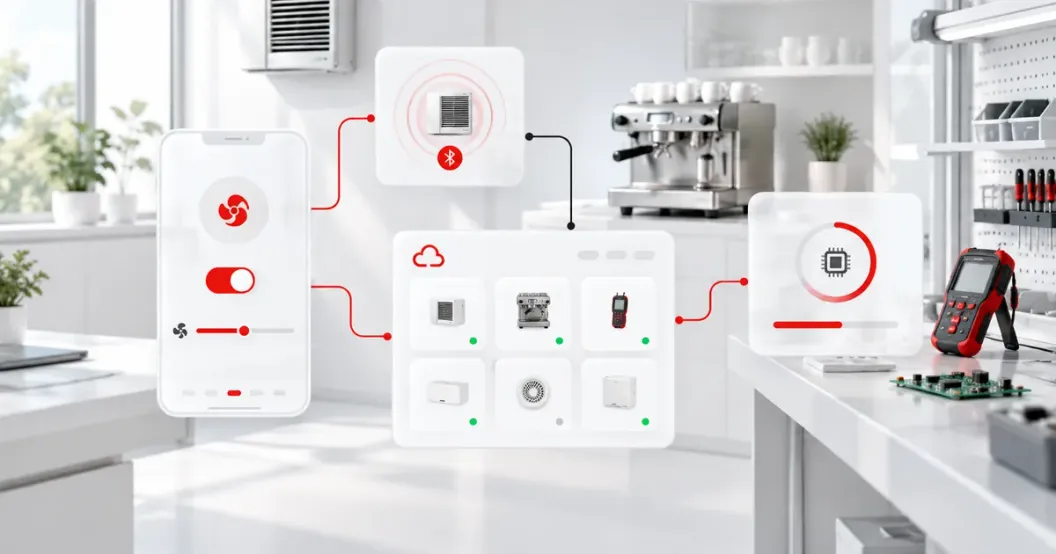
It depends on the device hardware and how it is used. Wearables and measuring instruments operated at close range suit Bluetooth direct connection; appliances and ventilation equipment that users control away from home need Wi-Fi and the cloud; gateways make sense only when a site has many sensors.
Many products combine methods, for example using Bluetooth for network setup and then Wi-Fi to reach the cloud. How Bluetooth Low Energy (BLE) connects and exchanges data is defined in the Bluetooth SIG's Bluetooth Core Specification; on the app side, the main work is the pairing flow, reconnection and compatibility across phone brands.
If the device itself uses radio frequencies such as Bluetooth or Wi-Fi, it must also meet the National Communications Commission's low-power radio-frequency device regulations before going on sale in Taiwan. The hardware team handles this, but the timeline should be planned together with the app.
How detailed should the communication protocol document be?
At minimum it should state the format of each command, the device's response format and what each error code means. The app is built from this document, so the more complete it is, the fewer rounds of rework you face during hardware testing.
If the firmware is still in development, agree on a draft first, develop both sides in parallel, and verify together on real hardware. JoinX aligns the communication protocol with the firmware team during requirements mapping, before designing the screens.
When do you need a cloud back end and OTA updates?
You need a cloud back end when devices must be controlled away from home, bound to accounts, managed in numbers by one person, or visible to customer service. Whenever firmware might be fixed or extended after launch, plan OTA updates.
OTA updates can be pushed through the app or the cloud, and should support staged rollouts, retries on failure, and a back-end view of each device's firmware version. If these are added after launch, the device firmware must change too, which costs more than planning them from the start.
HVAC and ventilation equipment maker: ventilation system app and admin back end
Approach: Since 2025 we have developed an app for an HVAC and ventilation equipment maker's air ventilation system, then extended it with an admin back end and API, and built a partner-brand version of the app with annual maintenance. This case started with a single-device app and added the back end and brand versions as the product required.
How should the app be planned when there are partner-brand or OEM versions?
Use one codebase that changes the look, name and feature set per brand, publish each separately, and manage each brand in the back end. This avoids rewriting for every brand, and a fix reaches all brands at once.
The prerequisite is treating the brand as a system setting from the start rather than copying the code. The ventilation equipment case above built the partner-brand version on top of the original app and back end.
What needs maintaining after a device app launches?
Mainly operating system updates. iOS and Android change every year, and Bluetooth permissions, background execution and push notification rules can all change; Google Play also requires apps to support new API levels by set deadlines, and Apple's review guidelines update privacy and permission requirements.
So after a device app launches, someone needs to regularly check pairing, control and push notifications on new phone versions and handle store reviews. The app store account should ideally be the hardware maker's own company account, so changing maintenance vendors later does not get stuck.
Coffee machine company: coffee machine control app
Approach: Since 2026 we have developed an app that lets users operate coffee machines from their phones, and have kept extending its features after launch.
Electronic instrument company: measuring instrument Android app and web version
Approach: Since 2024 we have developed an Android app for a measuring instrument, later adding web features and UI/UX improvements. Close-range devices such as measuring instruments often start with an app on a single platform and expand as users need.
Medical technology company and electric vehicle company
Approach: In 2025 we integrated Apple Watch health data and collected TrueDepth depth images for a medical technology company; in 2020 we developed an electric vehicle app for an electric vehicle company. Under confidentiality agreements, these cases are described by industry.
How much does device app development cost, and how long does it take?
Based on JoinX's custom project pricing in Taiwan, a single-device control app costs about NT$500,000 to 1.2 million, a feature-rich version with accounts, multiple devices, cloud back end, push notifications and OTA about NT$1.2 million to 3 million, and a platform with multiple brands and large device fleets starts at NT$3 million.
| Scope | Cost range | Typical scope | Timeline |
|---|---|---|---|
| Requirements and protocol mapping | NT$100,000–300,000 | Map devices, protocols and data flows, and produce a comparable spec | 2–4 weeks |
| Single-device control app | NT$500,000–1.2 million | Pairing, control and status display, with a simple back end | 6–12 weeks |
| Feature-rich | NT$1.2 million–3 million | Accounts and multiple devices, cloud back end, push notifications, OTA | 3–6 months |
| Platform | NT$3 million and up | Multi-brand versions, large device fleets, data analytics or AI | 6+ months |
Device firmware is handled by the hardware team or quoted separately; cloud hosting, push notifications and app store account fees are billed by actual usage. See IoT app development for the full scope, and How Bluetooth, Wi-Fi, and IoT connect devices for the business value they bring.
Frequently Asked Questions
Can we start the app before the firmware is finished?
Yes. Agree on a draft communication protocol and develop the app and firmware in parallel. The app side can build screens and flows with simulated data, then verify together once the firmware is ready for hardware testing.
Does a device app always need a cloud back end?
Not always. Bluetooth devices used only at close range, where storing data on the phone is enough, can skip the cloud at first. You need a cloud back end for remote control, accounts, multi-device management, or customer service visibility into device status.
Whose app store account should we use?
We recommend the hardware maker's own company account. The app is a brand asset, and publishing under your own account avoids getting stuck when you change maintenance vendors or transfer permissions.
Can one app serve different brands?
Yes. Use one codebase that changes the look, name and feature set per brand, publish each separately and manage them in the back end. Plan the brand as a system setting from the start.
How often does a device app need updates after launch?
At least once a year to keep up with major iOS and Android releases, plus prompt adjustments whenever Bluetooth permissions, background execution or push notification rules change. The actual frequency depends on device features and user reports.
Sources
- Bluetooth Core SpecificationBluetooth SIG
- Low-power Radio-frequency Devices Technical RegulationsNational Communications Commission (NCC), Taiwan
- App Store Review GuidelinesApple
- Target API level requirements for Google Play appsGoogle
These are the regulations and sources cited at the time of writing. Rules may be revised; always check the latest official announcement.
About the author
Jack Lee
Founder & CEO, JoinX
Jack founded JoinX in 2016 and leads a team of 80+ people across Taiwan and Japan. JoinX has delivered 520+ projects for 220+ clients, including 56 mid-to-large systems.
More about Jack