Technology Insights
How to Adopt AI Image Recognition: Data Preparation, PoC, Accuracy and Cost for Defect Detection (2026)
AI image recognition needs enough consistently labeled images first, then a PoC to prove accuracy, and only then integration into the production line or existing systems. Success depends far more on having enough defect samples and a consistent inspection standard than on which model you pick. This article covers where AI image recognition and defect detection fit, the adoption steps, how to set accuracy targets, cost and timeline, using the AI eddy current signal analysis system JoinX built for the National Atomic Research Institute (NARI) as a worked example.
Key takeaways
- JoinX's Taiwan custom-development pricing: a single-scenario AI image recognition PoC costs about NT$300,000 to NT$800,000, and a production launch about NT$800,000 to NT$2.5 million.
- Data is what makes AI image recognition work: you need enough defect samples and a consistent labeling standard, or no model will reach the accuracy you need.
- Accuracy is not a single number: first decide whether a missed defect or a false alarm costs more, then set acceptance thresholds accordingly.
- Most scenarios suit 'AI flags suspected defects, people review' rather than replacing human inspection from day one.
- JoinX built an AI eddy current signal analysis and automation system for the National Atomic Research Institute (NARI), starting with one channel and then extending to multiple channels.
Contents
JoinX's advice is to take stock of your data before talking about models. Whether you have enough defect samples and a consistent inspection standard decides whether the PoC passes; at JoinX's Taiwan custom-development rates, a single-scenario PoC costs about NT$300,000 to NT$800,000 and a production launch about NT$800,000 to NT$2.5 million. Below we cover where it fits, the adoption steps, how to set accuracy targets, cost, and how JoinX has done it in practice.
Where does AI image recognition fit?
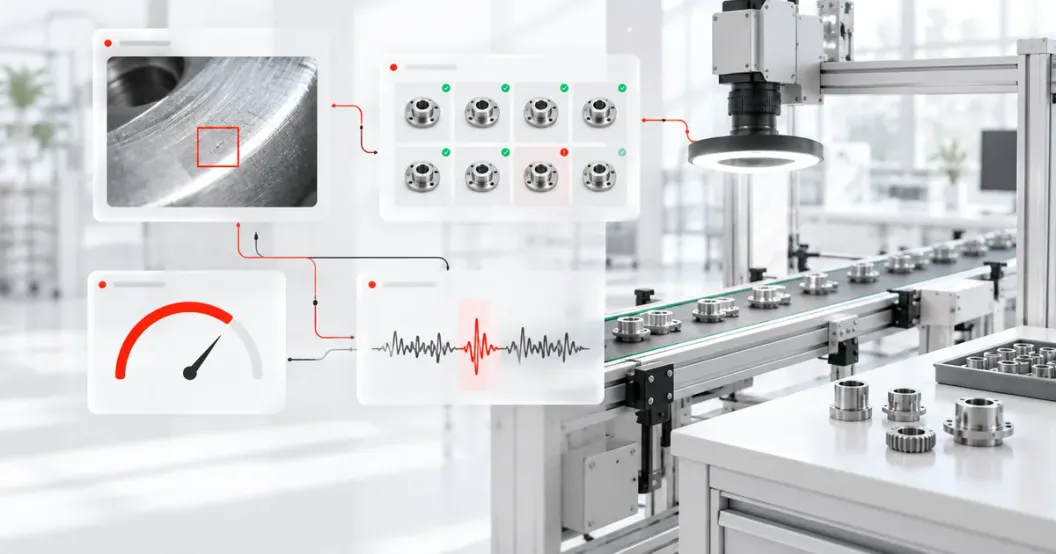
It fits high-volume inspection work where the rules are hard to write down but people can see the problem, such as defect detection, instrument signal analysis, and counting and classification. The common thread is that today people judge by eye, which is slow and varies from person to person.
| Scenario | Typical examples | What AI does | Difficulty |
|---|---|---|---|
| Surface defect detection | Scratches or chips on metal, plastic or electronic parts | Marks suspected defect locations and types | Medium: defect samples are often scarce |
| Instrument signal analysis | Signal plots and waveforms from non-destructive testing | Converts signals to images and judges whether they are abnormal | High: domain experts must help define the standard |
| Counting and classification | Item counts, product sorting, grading | Automatic counting and grading | Low to medium |
| Documents and forms | Receipts, ID documents, handwritten fields | Extracts field contents | Medium: harder when layouts vary |
| People and safety | Hard hats, restricted-area intrusion | Detects and alerts | Medium: involves personal data, so handle notice and retention first |
Checks with clear rules, such as whether a dimension is out of tolerance, are usually handled well by conventional image processing or measuring equipment; AI is not always needed.
How do you adopt AI image recognition?
Follow five steps: take stock of data, define the inspection standard, run a PoC, integrate and launch, and keep collecting samples. The first two are the most often skipped, yet they set the ceiling on PoC accuracy.
- Take stock of data. How many images you have, how many defect samples, and whether capture conditions (lighting, angle, resolution) are consistent. If defect samples are scarce, plan how to collect more first.
- Define the inspection standard. Your most experienced inspectors and the development team write down what counts as a defect and how defects are classified, as labeling rules another person can reproduce.
- Run a PoC. Pick one product, one defect type or one signal channel, and use limited data to verify the model can reach the agreed threshold.
- Integrate and launch. Connect the model to capture equipment, existing software or reporting, and add a human review interface, permissions and logging.
- Keep collecting samples. After launch, collect misjudged cases, relabel them and retrain regularly so the model improves over time.
This process also matches what NIST's AI Risk Management Framework (AI RMF 1.0) emphasizes: define the intended use and risks before deployment, then keep measuring and monitoring after launch.
How should you set accuracy targets for AI image recognition?
First decide whether a missed defect or a false alarm costs more, then set thresholds. Safety-related inspection usually prefers to over-flag and let people review rather than miss anything; routine visual checks need to limit false alarms so the line does not keep stopping.
| Metric | Meaning | When it matters most |
|---|---|---|
| Miss rate | A real defect the AI did not flag | Inspection with high safety or quality liability |
| False alarm rate | No defect, but the AI flagged one | High-volume scenarios where false alarms slow the line |
| Consistency | Whether rerunning the same image gives the same result | Inspection that must be audited or traced |
| Processing time | How long each image or batch takes | Lines with a fixed cycle time |
Acceptance testing should use images the model has never seen, with a defect ratio close to real conditions. ISO/IEC 22989's definitions of AI systems, training data and validation are a useful shared vocabulary so both sides mean the same thing by "accuracy."
What AI image and signal analysis projects has JoinX delivered?
JoinX has built AI analysis of nuclear inspection signals and image data collection for a medical technology company. In both, we got the data and process right first and then widened the scope in phases.
National Atomic Research Institute (NARI): AI eddy current signal analysis and automation system
Starting point: Eddy current testing is widely used to inspect metal piping, steam generator tube bundles and heat exchangers in nuclear reactors. Interpretation depended heavily on expert experience, manual analysis of large volumes of signals was slow, and results varied between people. Nuclear data is highly sensitive and access requires strict review, while defect samples are rare, leaving the data extremely imbalanced.
What we built: JoinX owned the project from planning to launch. The model layer uses convolutional neural networks (CNNs) built with TensorFlow; because signal characteristics differ sharply between channels, we built a dedicated model for each and combined information from multiple bands for a unified judgment. The automation layer combines OpenCV with GUI automation to open files, locate signal points, capture images and produce reports automatically. We developed "AI recognition" and "automation control" as separate systems, and followed a "single channel first, multiple channels later" order, building base models on channels with clear signal features first to lower technical risk. See the NARI case study for the full approach.
Working together: 2022 to 2025.
Medical technology company: depth image data collection
Starting point: Training a model first requires consistent, usable image data.
What we built: JoinX integrated Apple Watch wearable data and used the iPhone's depth camera to collect image data as the foundation for model training.
Working together: 2025.
For other AI projects, see enterprise AI adoption cases.
How much does AI image recognition cost, and how long does it take?
Based on JoinX's Taiwan custom-development pricing, a single-scenario AI image recognition PoC costs about NT$300,000 to NT$800,000, a production launch for one scenario about NT$800,000 to NT$2.5 million, and multi-line or multi-defect integration is quoted by scope.
| Stage | Estimated cost | Typical contents | Typical timeline |
|---|---|---|---|
| Needs assessment | 1–2 meetings | Review existing images and processes, judge whether AI fits, suggest a first scenario | 1–2 weeks |
| Single-scenario PoC | NT$300,000–800,000 | One defect type or signal channel, limited data, human review | 4–8 weeks |
| Production launch (one scenario) | NT$800,000–2.5 million | Connect equipment or existing software, review interface, permissions, logging and deployment | 2–4 months |
| Multi-line or multi-defect integration | Quoted by scope | Multiple models, cross-system work, ongoing retraining | 4 months or more |
At JoinX's rates, an AI image recognition PoC costs about NT$300,000 to NT$800,000 and a single-scenario launch about NT$800,000 to NT$2.5 million; cameras, lighting, GPU servers and labeling labor are usually extra, and cost depends mainly on the number of defect samples, the complexity of the inspection standard and the systems to integrate. These figures are a starting point for budgeting, not a fixed quote.
What should you prepare before starting AI image recognition?
Prepare existing images and defect samples, an on-site expert who can define the standard, the first scenario to validate and the acceptance thresholds. The more concrete these are, the faster the PoC reaches a conclusion.
- Organize existing images and defect samples. Roughly how many images per defect type, whether capture conditions are consistent, and whether the data can be shared with the development team.
- Assign an on-site expert. They define defect categories and confirm labels, and need time each week during the PoC.
- Choose the first scenario. Pick the one with stable imaging, clearly defined defects and a manageable cost of error.
- Agree acceptance thresholds. Decide how much miss rate and false alarm rate are acceptable and put it in the contract, so there is no argument afterwards about whether it is "accurate."
- Confirm data and privacy rules. If images contain faces or other identifiable personal information, collection, retention and deletion must comply with Taiwan's Personal Data Protection Act.
FAQ
How many images does AI image recognition need?
There is no fixed number; it depends on how many defect types there are and how much images vary. More important than the total is having enough samples for each defect type and a consistent labeling standard. When defect samples are scarce, start the PoC with one clearly defined type while planning to collect more data.
Can AI fully replace human inspection?
In most scenarios we do not recommend full replacement from the start. A safer approach is for AI to flag suspected defects and people to review, then gradually narrow what needs review once accuracy is stable on real data. Safety-related inspection usually keeps human confirmation permanently.
We already have inspection equipment or software. How does AI connect?
It can sit after the existing process, reading the images or signals the equipment outputs and writing results back to reports. The system JoinX built for NARI operates the existing software automatically, opening files, locating signals, capturing images and producing reports, without replacing the original inspection equipment.
Does the model need maintenance after launch?
Yes. Material changes, aging lights or a shifted camera angle all reduce accuracy. After launch you need to keep collecting misjudged cases, relabel them and retrain regularly, and monitor each batch's results for unusual shifts.
Who owns the source code and the model?
The full source code and trained models are handed over to the client. JoinX develops with its own in-house team without subcontracting, so you can maintain it yourself, sign a maintenance contract or hand it to another team; just put the model, the handling of training data and handover documents in the contract.
Sources
- AI Risk Management Framework (AI RMF 1.0)NIST
- ISO/IEC 22989:2022 Artificial intelligence concepts and terminologyISO/IEC
- Personal Data Protection ActMinistry of Justice, Taiwan
These are the regulations and sources cited at the time of writing. Rules may be revised; always check the latest official announcement.
About the author
Jack Lee
Founder & CEO, JoinX
Jack founded JoinX in 2016 and leads a team of 80+ people across Taiwan and Japan. JoinX has delivered 520+ projects for 220+ clients, including 56 mid-to-large systems.
More about JackRelated articles
 How to Integrate a Payment Gateway in Taiwan: Choosing a Provider, the Integration Steps, Reconciliation and Cost (2026)
 How to Choose an Online Course Platform: Course Marketplaces, Course SaaS, LMS and Custom Development Compared, with Features and Cost (2026)
 How to Choose a POS System: Packaged, Cloud and Custom POS Compared, with Hardware, Integration and Cost (2026)