What Is AI-Assisted Development? Lower Cost, Higher Quality
AI-assisted development is an approach in which engineers use AI to move design, implementation, testing, and documentation forward. JoinX explains how it keeps costs down while maintaining quality, which roles must stay with people, and the seven stages of adopting it.

Contents
AI-assisted development is an approach in which people make the decisions while AI supports requirements, implementation, testing, and documentation.
"If you're developing with AI, shouldn't the cost drop by half or more?" We hear this question often. The short answer: the savings are about 30%. In this article, we open up JoinX's actual development process to explain where that 30% comes from, and why it doesn't become 50%.
AI-assisted development is not "letting AI write the code"
First, let's clear up a misconception. Throwing requirements at an AI and taking back whatever code it produces, so-called vibe coding, can produce a working demo, but not a system that holds up in real production. Security, integration with existing systems, and exception-handling design all fall through the cracks.
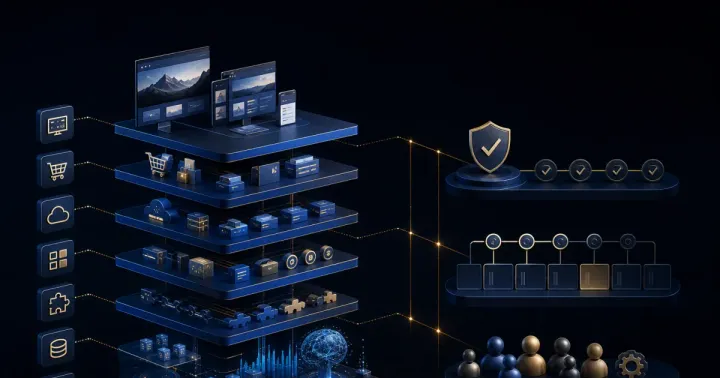
As JoinX defines it, AI-assisted development is an approach that sets clear points for AI participation at each stage of the development process, while every decision point remains with a senior engineer. AI is the accelerator, not the driver.
What AI handles across the seven stages
| Stage | AI handles | People handle |
|---|---|---|
| Clarifying requirements | Organizing interview notes, drafting requirements, detecting contradictions in specifications | Business decisions, setting priorities |
| Defining specifications | Drafting specifications, API definitions, identifying edge cases | Architecture decisions, technology selection |
| Design | Generating UI variations, checking design consistency | Design decisions, brand expression |
| Implementation | Boilerplate code, CRUD, drafting unit tests | Core logic, architecture, code review |
| Quality verification | Generating test cases, regression testing, initial vulnerability scans | Designing acceptance criteria, scenario testing |
| Deployment | Deployment scripts, verifying environment settings | Release decisions, risk assessment |
| Maintenance and operations | Log analysis, anomaly detection, keeping documentation in sync | Root-cause judgment, evolving the architecture |
The key point is that AI-generated code must always pass a senior engineer's review before it enters the project. That is the dividing line between "AI-assisted" and "leaving it all to AI."
Cost structure: where the 30% comes from
Here is the cost breakdown of a conventional development project compared with the same project after adopting AI-assisted development.
| Item | Conventional | With AI assistance |
|---|---|---|
| Requirements and specification documents | 15% | About 8% |
| Boilerplate code and repetitive implementation | 25% | About 10% |
| Core logic and architecture | 25% | 25% (unchanged) |
| Testing | 20% | About 12% |
| Documentation and handover | 10% | About 5% |
| Communication and management | 5% | 5% (unchanged) |
The reductions are concentrated in repetitive work. The investment in core logic, architecture design, and security does not change. That is why the cost falls by 30% rather than by half.
Why quality actually improves
Intuitively, "fast" means "sloppy," but in practice we see the opposite. There are three reasons.
Testing no longer gets cut. In conventional projects, testing was the first thing to go when deadlines got tight. With AI, the cost of generating test cases has dropped to almost zero, so testing has shifted from "if there's time" to "fully covered by default."
Documentation stays in sync with the code. Design documents used to be written all at once just before delivery, so they tended to drift from the implementation. With AI-assisted development, documentation is updated alongside development, which fundamentally changes the quality of handover and maintenance. Japanese companies' projects often treat documentation quality as an evaluation criterion, so we believe this effect is especially significant for them.
Senior engineers spend their time on decisions. Once AI absorbs the repetitive work, senior engineers can devote their time to architecture, review, and exception design.
Four areas we don't leave to AI
Business decisions. Which features to build, and which not to build. This belongs to people who understand the business context.
Architecture design. How to design a structure that can handle the business at its scale three years from now. This requires judgment grounded in experience.
Security and compliance. AI writes "code that runs," but that is not the same as "code that passes a security assessment." The management processes of ISO 27001 cannot be delegated to a model.
Accountability. When an incident occurs, someone has to see it through to the end. This is a matter of contracts and organization, and technology cannot replace it.
Frequently Asked Questions
Q1. How much does AI-assisted development reduce costs? A. About 20–30% overall. The higher the share of routine work in a project, the larger the reduction; the more complex the core logic, the smaller it is.
Q2. Is AI-written code secure? A. AI-generated code that has not been reviewed carries known risks. At JoinX, every piece of AI-generated code is reviewed by a senior engineer and passes a vulnerability scan before it is merged into the project.
Q3. Who owns the rights to the source code? A. As with conventional development, 100% belongs to the client.
Q4. Will our code or data be used to train AI? A. No. JoinX uses enterprise-grade services and operates under the management processes of ISO 27001:2022.
Q5. How much shorter is the schedule? A. As a guideline, about 20–35% overall.
Q6. Do small projects benefit from AI-assisted development too? A. Yes. In fact, small projects with a high share of routine work tend to see larger reductions.
Q7. Can AI-assisted development be used to modify existing systems? A. Yes, it is effective. AI is especially strong at reading existing code and rebuilding documentation, which can significantly lower the cost of takeover projects.
Q8. How can we verify that a vendor actually practices AI-assisted development? A. Check whether they can explain concretely which stages use AI and how their review process works. If they cannot explain the stages, it may just be sales language.
Conclusion
AI-assisted development reduces repetitive work; the decisions and the accountability stay the same. That is exactly why the same budget buys broader test coverage, better-organized documentation, and the judgment of more experienced engineers.
By combining Taiwan's offshore rates with the efficiency of AI-assisted development, a cost of 40–60% of what the same work would cost when commissioned within Japan becomes a realistic level.
About the author
Jack Lee
Founder & CEO, JoinX
Jack founded JoinX in 2016 and leads a team of 80+ people across Taiwan and Japan. JoinX has delivered 520+ projects for 220+ clients, including 56 mid-to-large systems.
More about Jack